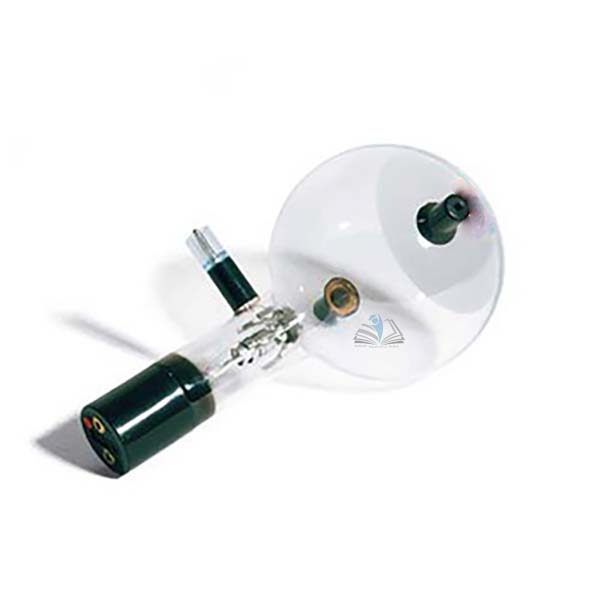
Quick Answer: Teltron Tube - Electron Diffraction is a highly evacuated electron tube that shows the wave nature of electrons through Debye-Scherrer diffraction rings formed as electrons pass through polycrystalline graphite.
Last updated: October 2026
Key Features
Electron gun with indirectly heated cathode projects a narrow converging beam
Thin graphitised carbon layer on a fine mesh grid over the gun exit aperture
Diffraction rings appear on the phosphor-coated end of the tube
Wavelength found from ring radii and graphite lattice plane spacing at different anode voltages
Used for confirming de Broglie's hypothesis
Operating instructions supplied
Technical Specifications
Specification
Value
Maximum anode voltage
5 kV
Anode current
0.15 mA at 4 kV
Maximum filament voltage
7.5 V AC/DC or less
Lattice constant of graphite
d10 = 0.213 nm; d11 = 0.123 nm
About This Product
Studying how the ring pattern changes with anode voltage permits verification of de Broglie's hypothesis, shows the dual nature of the electron and lets the spacing of the diffracting planes be calculated, suggesting the probable arrangement of carbon atoms. Operation needs a universal stand, a bench power supply for the filament, 4 mm leads, an EHT power supply for the anode and 3 EHT experiment leads.
Frequently Asked Questions
Q1. What graphite lattice spacings apply? The lattice constants of graphite are d10 = 0.213 nm and d11 = 0.123 nm.